Pennsylvania’s Floor Coating Experts. Durable. Slip-Resistant. Installed in One Day [Get Free Quote]

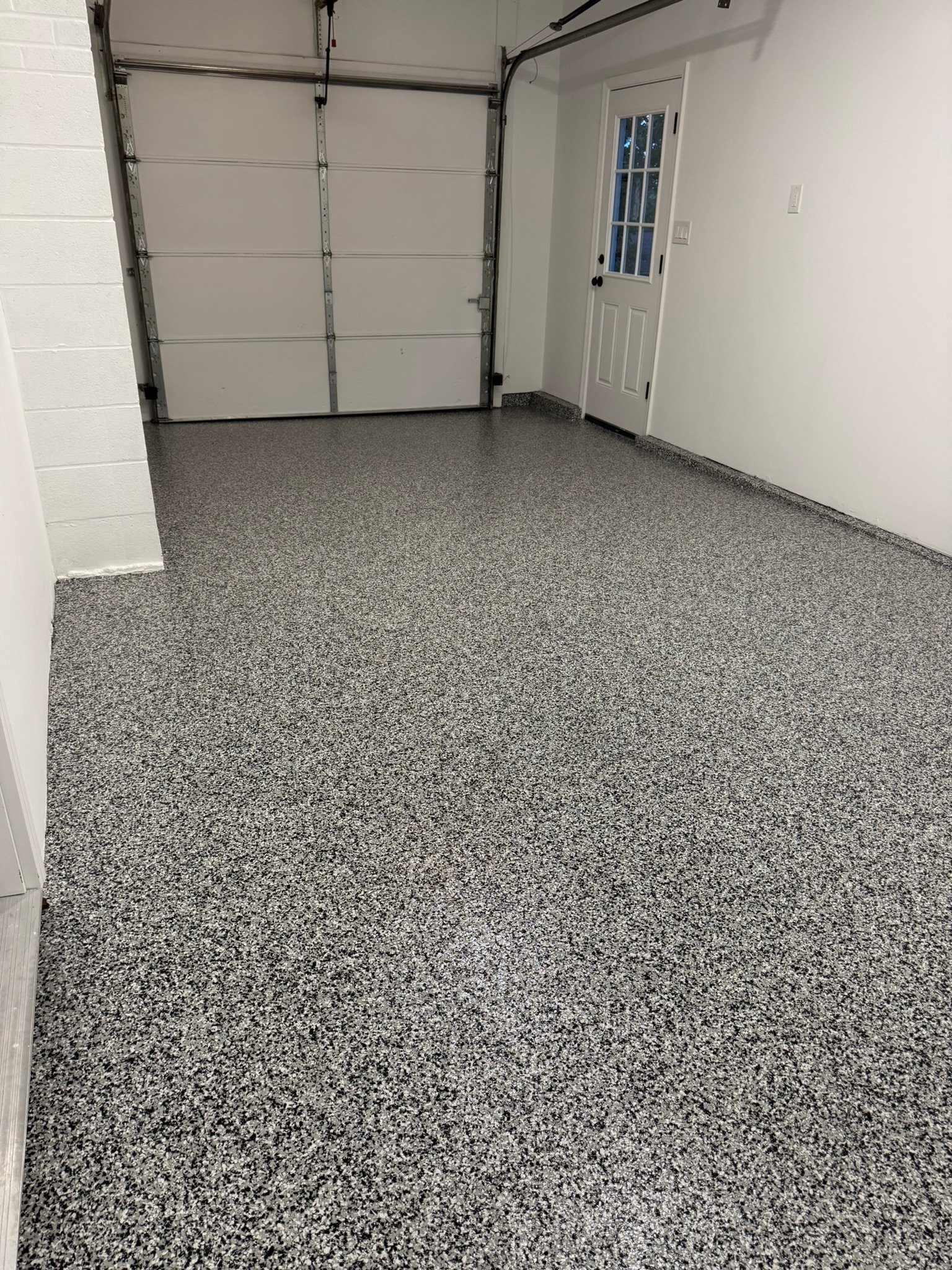
Most polyaspartic versus epoxy comparisons repeat the same three bullet points: polyaspartic cures faster, resists UV better, and costs more. All three are true, but none of them explain why, which means the comparison never actually helps you judge a company’s claims about either product. This article goes one level deeper, into the actual chemistry, and ends with our honest opinion after installing both for years.
Standard epoxy resin is typically made from a reaction between bisphenol A and epichlorohydrin, cross-linked with an amine hardener into a rigid molecular network. That network includes aromatic rings, benzene-based structures that are part of what makes epoxy strong and chemical-resistant in the first place. The problem is that those same aromatic rings absorb ultraviolet light in exactly the wavelength range present in ordinary sunlight. Absorbing that UV energy breaks down the molecular structure over time, which is the direct chemical cause of the yellowing, chalking, and gradual loss of structural integrity that every epoxy floor eventually shows once it has spent enough time exposed to sunlight, whether through garage windows, an open garage door, or direct outdoor exposure.
Polyaspartic coatings are a type of aliphatic polyurea, built from a polyaspartic ester reacting with an aliphatic polyisocyanate. The word aliphatic is the key difference: it means the molecular backbone does not contain the benzene rings that make epoxy vulnerable to UV breakdown in the first place. Without those rings, polyaspartic simply does not absorb the damaging wavelengths of sunlight the same way, which is the actual chemical reason it stays clear and stable for years in conditions that would yellow and chalk a standard epoxy within a single season.
The polyaspartic ester itself is also a hindered diamine, meaning its molecular structure is designed to slow down its reaction with the isocyanate component compared to a standard, unhindered polyurea, which reacts almost instantly and would otherwise be nearly impossible to apply evenly by hand. That steric hindrance is what gives an installation crew a workable window to spread and broadcast flake into the material, while still curing to a walkable surface in hours rather than the days a standard epoxy system typically requires.
The bonds holding a polyaspartic system together are predominantly urea linkages, while epoxy relies more on ether linkages within its cross-linked network. Urea linkages are meaningfully stronger and more thermally stable than ether linkages, which translates directly into better elasticity and impact resistance in the finished floor. That flexibility matters specifically in a Pennsylvania climate, where a garage or outdoor slab goes through real freeze-thaw cycling every winter. A more flexible coating expands and contracts along with the concrete underneath it instead of fighting against that movement, which is a meaningful part of why a correctly installed polyaspartic system tends to avoid the hairline cracking that shows up in more rigid coatings after a few winters of temperature swings.
This kind of independent, hands-on comparison is worth watching if you want to see the practical differences for yourself rather than taking any single installer’s word for it, ours included.
Epoxy was the standard residential floor coating material for roughly two decades before polyaspartic chemistry became commercially practical for this kind of application. Polyaspartic itself was originally developed for industrial pipeline coatings and certain military-grade protective applications, where its combination of chemical resistance and fast cure time were valuable long before anyone was broadcasting color flake into it for a homeowner’s garage. As the raw material became more widely available and manufacturers developed flake-compatible formulations, professional installers who actually study coating systems rather than just selling whatever they have always sold began making the switch, quietly, because their customers cared about the floor holding up, not about brand loyalty to a specific chemistry. The word epoxy has stuck around in everyday language mostly because it is the term homeowners already know, even when the actual material going down on the floor is polyaspartic.
All of this chemistry translates into real, observable differences on an actual floor. Hot tires are a good example: a vehicle that has been driven for twenty minutes and then parked can leave the rubber soft enough to bond slightly to a coating that is not fully cross-linked or UV-stable, a problem known as hot tire pickup. Polyaspartic’s faster, more complete cure and better chemical stability make it meaningfully more resistant to this than many epoxy systems. Winter road salt is another real-world test: the chemical resistance built into polyaspartic’s urea-based structure holds up to repeated salt exposure better than an epoxy surface that has already started breaking down from UV exposure.
Outdoor applications make the difference even more pronounced. A patio, porch, or pool deck gets far more direct, sustained sunlight than a garage with a closed door most of the day, which means the UV-driven degradation that affects epoxy happens faster and more visibly outdoors than it would inside. This is part of why polyaspartic has become close to the default choice for any outdoor concrete coating, not just a premium upgrade option, since epoxy’s UV vulnerability is simply a bigger practical problem outside than it is in a dim garage.
None of this chemistry discussion changes the fact that polyaspartic generally costs more per square foot than a basic epoxy system, and it is worth being upfront about why. Polyaspartic raw materials cost more to manufacture than standard epoxy resin, the formulation process to achieve that hindered reaction time is more technically demanding, and the faster cure time that makes installation more convenient for the homeowner also compresses the installer’s working window, which takes more skill and experience to manage correctly on site. None of that is marketing. It is simply a more expensive material to produce and install correctly, which is reflected honestly in what it costs compared to a basic epoxy coat.
We will be direct about this: we do not install standard epoxy as a primary floor system anymore, and the chemistry above is exactly why. It is not that epoxy is a bad material in every application. It has its place, particularly in fully enclosed, climate-controlled industrial settings with no UV exposure at all, where its chemical resistance and cost are genuine advantages. But for a Pennsylvania garage, basement, patio, or pool deck, all of which see real sunlight and real freeze-thaw cycling, we think installing epoxy and letting a customer discover the yellowing and cracking in a year or two is a worse outcome than simply being upfront that polyaspartic is the better material for these specific conditions, even though it costs more per square foot. That is our honest opinion after years of installing both, and after fixing more than a few failed epoxy floors that a customer paid full price for the first time around, only to pay again for a proper polyaspartic recoat once the epoxy started failing.
In our opinion, mainly in fully enclosed, climate-controlled industrial spaces with no UV exposure at all, where epoxy’s lower cost and strong chemical resistance can make sense. For any residential garage, basement, or outdoor surface in Pennsylvania, we recommend polyaspartic without hesitation.
A properly formulated aliphatic polyaspartic topcoat should not yellow under normal sun exposure, since its molecular structure does not contain the UV-absorbing aromatic rings that cause epoxy to yellow. This is one of the clearest practical differences between the two materials.
Often simply because it is what they have always used, it is cheaper per square foot, and switching product lines takes investment in new equipment and training. That does not make it the better choice for an outdoor-exposed or UV-exposed floor.
Based on how much longer a polyaspartic system realistically lasts in sunlight and freeze-thaw conditions compared to standard epoxy, we believe the cost difference pays for itself well before either coating would need replacing.
Yes, this is a common upgrade path. The existing epoxy typically needs to be ground off to re-expose a proper surface profile before a new polyaspartic system is installed on top.
Some manufacturers offer hybrid polyurea and polyaspartic blends that sit between the two in cost and overall performance. For most residential jobs, we have found a true polyaspartic system is worth the modest additional cost over a hybrid product, given how much of the UV stability advantage comes specifically from the aliphatic chemistry discussed above, rather than from the blend alone.