


Pennsylvania’s Floor Coating Experts. Durable. Slip-Resistant. Installed in One Day [Get Free Quote]

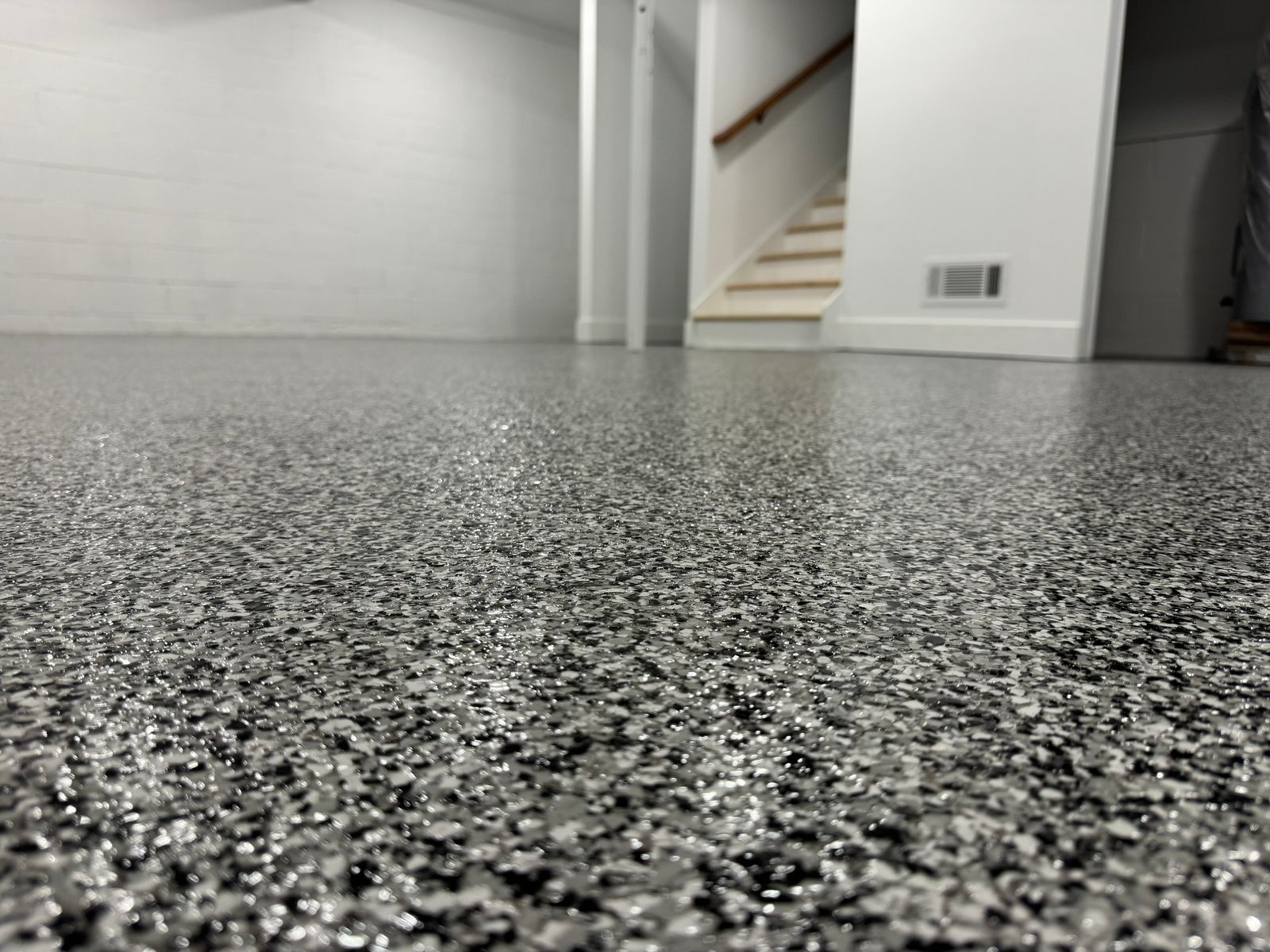
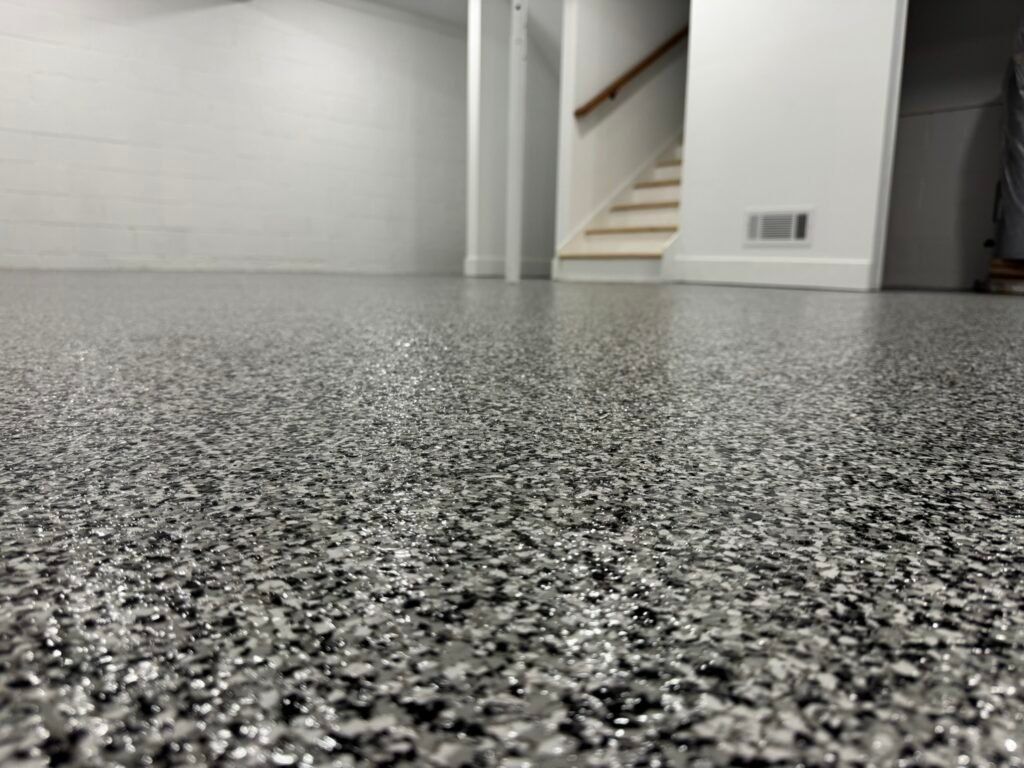
A below grade basement in Manheim, PA gets a dark gray, black and white flake floor that can handle moisture and foot traffic at the bottom of the stairs.
Basements take a different kind of wear than a garage. There is usually less oil and no tires rolling across it, but there is more foot traffic, more humidity, and in a lot of older homes around Manheim, an occasional damp spot near the foundation wall after a heavy rain. This homeowner wanted the space at the bottom of the stairs to actually feel like part of the house, not just a slab that happened to be under a roof.
Before we started, the floor was bare gray concrete, the same as the day the house was built. It was usable for storage, but nobody wanted to spend real time down there.
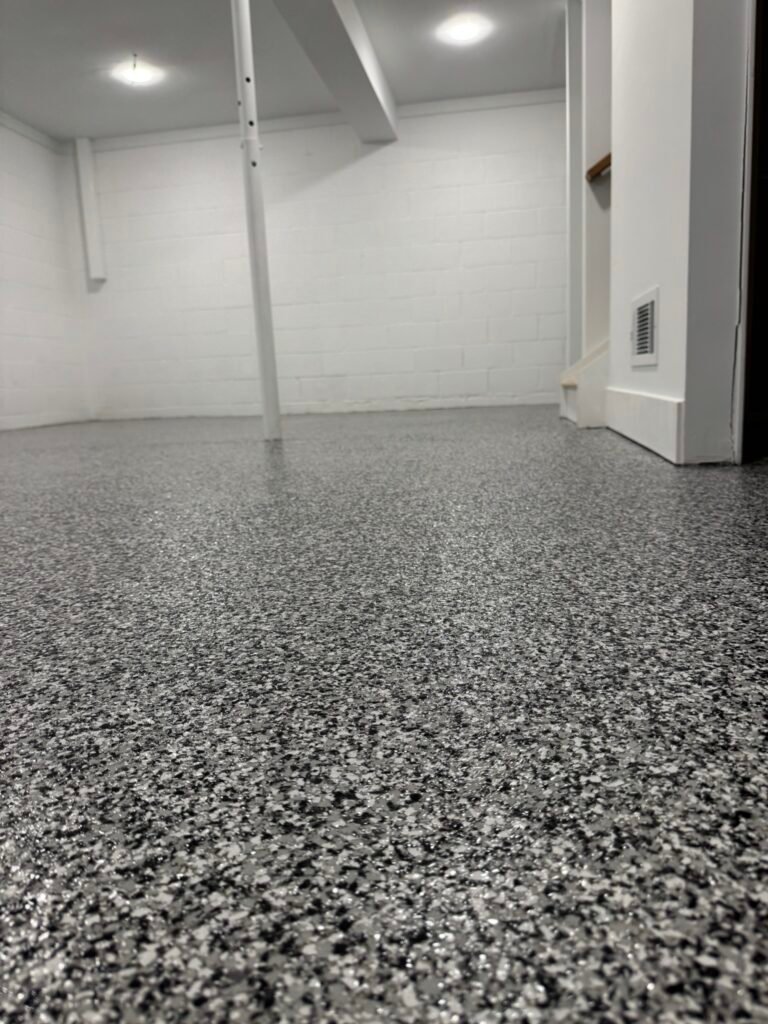
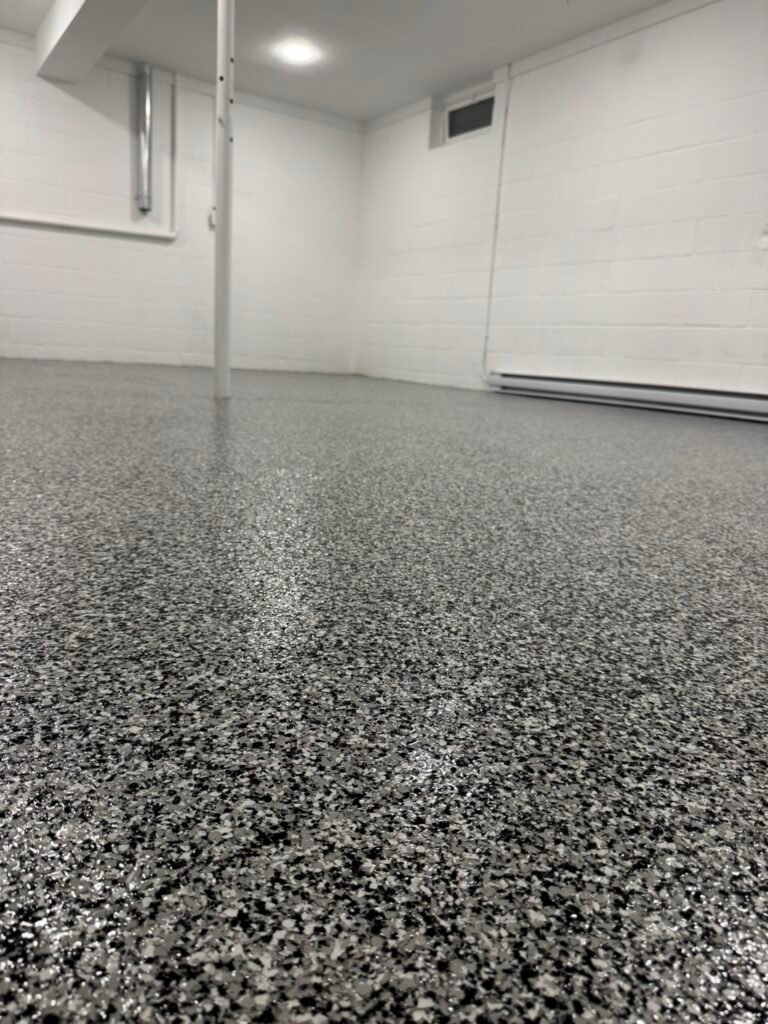
Basement floors get a similar system to a garage, but the prep work is different because the concrete is below grade and sits closer to the water table. We grind the slab with diamond tooling to remove any old sealer, paint, or curing compound and open up the surface, but we also pay close attention to moisture. Basement slabs can hold moisture vapor that never fully leaves the concrete, and if you coat over that without accounting for it, the coating can eventually blister or lift, especially near the foundation walls.
Once the floor is ground and checked, we apply a polyaspartic base coat suited to a below-grade environment. It bonds into the freshly opened concrete rather than sitting on top of it like a thick paint would. Then we broadcast the flake blend by hand to full coverage across the room, working around support posts, stairs, and any mechanical equipment along the way.
After the flake sets, we scrape it flush and vacuum up anything loose, then roll on a clear polyaspartic topcoat to seal the whole floor. In a basement, that topcoat is doing a slightly different job than in a garage. There is less concern about hot tires and road salt, and more about everyday foot traffic, the odd spill, and keeping the room from feeling like an unfinished concrete box.
We went with a dark gray, black and white flake blend for this basement. Darker blends tend to work well in below grade rooms because they hide the kind of light scuffing that happens near a staircase landing, where people are constantly stepping on and off the last step.
On install day, the garage needs to be completely empty, vehicles, tools, shelving, storage bins, all of it, so the crew can grind and coat every square foot without stopping to work around anything left behind. Grinding does create dust, so we run vacuums attached to the grinding equipment to keep it contained rather than letting it spread through the garage and into the house. Once the topcoat is down, the floor needs to stay clear for the rest of that day. Most homeowners park in the driveway for a day or two while everything fully cures.
The biggest factors that affect price on a garage floor are square footage, the condition of the existing concrete, and the flake blend chosen. A one car garage with a clean, crack free slab is the least expensive version of this job. Cracks that need to be routed and filled, stains that take extra grinding to remove, or a larger multi car garage all add time and material, which is reflected in the price. We do not quote sight unseen over the phone for exactly this reason: two garages that look similar in photos can need very different amounts of prep work once we actually grind the surface and see what is underneath the stains.
A lot of basements in this part of Lancaster County were poured decades ago, before modern vapor barriers were standard practice. That means the concrete itself can carry more moisture than a newer slab, especially during humid summer stretches. That is exactly why we check for moisture before coating rather than assuming every basement floor behaves the same way a garage floor does.
Cleaning this floor day to day is about as simple as it gets: a broom or shop vac for dust, and a mop with warm water and a mild degreaser or dish soap for anything oily. Avoid harsh acid based cleaners and steel wool, which can dull the topcoat over years of use. There is no yearly resealing or waxing required the way there would be with a painted or bare concrete floor.
Homeowners looking at garage floor options usually end up comparing three things: leaving the concrete bare, painting it with a roll on epoxy kit, or going with a professionally installed flake system like this one. Bare concrete is free but keeps staining, dusting, and looking unfinished no matter how often it gets swept. A do it yourself epoxy kit looks decent for the first few months, but most kits skip real diamond grinding, which is the step that actually determines whether a coating bonds for years or peels within one winter. A professionally ground and coated flake floor costs more up front than a kit from a hardware store, but it is built to actually last, which is the whole point of doing this kind of project in the first place.
It depends on the source and severity of the moisture. Minor humidity related dampness is something the system is designed to handle. Active water intrusion, like a crack that lets water in during heavy rain, needs to be addressed separately before any coating goes down, otherwise you are just sealing a problem underneath a nice looking floor.
No. Polyaspartic coatings have very low odor compared to older epoxy systems, and what smell there is clears within a day or two. Most homeowners are back to using the space normally within a few days.
Yes. A lot of homeowners coat the floor first as a way to use the space right away, then add framing, drywall, or a drop ceiling later. The floor does not need to be redone or protected during that kind of renovation work, it just needs a normal drop cloth like any finished floor would.
Not noticeably more than bare concrete already does. Concrete is concrete either way. What changes is that the surface is sealed and smooth rather than porous and dusty, which honestly feels more comfortable to walk on barefoot than raw concrete ever does.
It helps somewhat, since it seals the concrete instead of letting moisture wick straight through it, but it is not a fix for an active water problem or a musty smell coming from somewhere else in the basement, like a leaky window well.
Yes, we work around a sump pump lid or floor drain the same way we would around a support post, grinding and coating right up to the edge without covering anything that needs to stay accessible.
A little, yes. Darker blends like the one used here tend to work well in basements because most below grade rooms get less natural light than a garage with a big door open during the day, and a darker floor does not show dust the way a very light blend would under artificial light.
Grinding does create dust, which we contain with vacuum attached equipment, and there is a mild odor from the coating for a day or so. Most homeowners stay in the house during the work without any real disruption to the rest of their routine.
The most common mistake we see in basements is someone coating over a slab that was never checked for moisture, usually with a cheaper paint style product bought online. It can look fine for a season and then start bubbling once humidity picks up in the summer. Checking the floor properly before coating takes very little extra time and it is the difference between a basement floor that lasts and one that needs to be redone in a year or two.
FlakePro Coatings installs the same polyaspartic flake system in garages, basements, patios, sunrooms, and commercial buildings all over Lancaster County and the towns around it. If you want to see more of our work or get a quote for your own floor, here are some good places to look next.
Garage Floor Coating in Mount Joy, PA
Walkway and Stairway Restoration with Polyaspartic Flake Coating
See our full project gallery.
Read more about our work as an epoxy floor coating contractor.
Request a free estimate and we will get back to you with a real number, not a guess.