Pennsylvania’s Floor Coating Experts. Durable. Slip-Resistant. Installed in One Day [Get Free Quote]

Every spring, we get a wave of calls from homeowners in Lancaster County and Lebanon County saying the same thing: “I had my floor coated two years ago and it’s already coming up.” Sometimes it’s a DIY project that failed. Sometimes it’s a contractor who charged good money and still cut corners. Either way, the result is the same – flaking, peeling concrete that looks worse than the bare floor they started with.
This article walks through the five most common reasons garage floor coatings fail in Pennsylvania – and more importantly, what a properly installed floor looks like so it doesn’t happen to you again.
The single biggest reason garage floor coatings peel in Pennsylvania and everywhere else — is inadequate surface preparation. Specifically: the concrete was cleaned with acid etching instead of being mechanically profiled with diamond grinders.
Here’s why that matters. Concrete has a natural top layer called the laitance — a weak, dusty surface crust that forms during the curing process. Acid etching removes surface contamination and opens some pores, but it does not remove the laitance layer. A coating applied over laitance bonds to that weak layer, not to the solid concrete beneath it. When stress comes — from tire weight, temperature change, or moisture — the laitance gives way and the coating lifts off with it.
Diamond grinding physically removes the laitance and profiles the concrete at a microscopic level, creating millions of small anchor points for the coating to bond to. This is why a properly ground surface holds for 15–20 years while an acid-etched surface may peel within 1–2 winters.
According to the American Concrete Institute (ACI), mechanical preparation is the industry standard for any coating system expected to last — and acid etching alone is explicitly insufficient for professional applications. (external source)
Concrete is porous. Even a garage floor slab that looks bone dry on the surface is constantly releasing moisture vapor that travels upward from the soil beneath it. This is called moisture vapor transmission (MVT), and it is one of the leading causes of coating failure across Central Pennsylvania.
When a coating is applied to a slab with high moisture vapor emissions particularly without a moisture-mitigating primer — the vapor pressure builds beneath the coating over months. Eventually it has nowhere to go. The coating blisters, bubbles, and lifts. You’ll see it first along walls and at low spots where vapor concentrates.
Lancaster and Lebanon County homes are particularly vulnerable. Our high water table, clay-heavy soils, and older construction with minimal under-slab vapor barriers mean that a significant percentage of residential garages here have elevated moisture vapor readings. A coating installed without testing for this — regardless of how good the product is has a real chance of failing.
Pennsylvania’s climate puts coatings through extreme stress. Lancaster and Lebanon County experience temperature swings of more than 80°F between January and July. That’s not just a number — it’s a material science problem.
Concrete expands and contracts with temperature. A rigid coating that can’t flex with the concrete will crack and delaminate over repeated thermal cycles. Standard epoxy — the product used by most big-box installers and DIY kits — has a low flex modulus, meaning it resists movement. In an indoor climate-controlled environment, this is fine. On a garage floor that goes from 10°F in January to 90°F+ in July, it’s a failure waiting to happen.
| Property | Polyaspartic (professional) | Standard epoxy |
|---|---|---|
| Flex modulus | 400–600 PSI — flexes with concrete | <50 PSI — cracks under movement |
| UV stability | Fully UV-stable, won’t yellow | Yellows and chalks outdoors |
| Road salt resistance | Sealed, impermeable surface | Partial — degrades over time |
| Freeze-thaw performance | Designed for outdoor conditions | Designed for indoor use only |
| Expected lifespan in PA | 15–20+ years | 3–7 years before failure |
This is why we exclusively use polyaspartic floor systems — not because it’s a marketing word, but because the material is genuinely engineered for the temperature swings, road salt, and moisture that come with Pennsylvania winters. For the full comparison, see our article: How Long Does an Epoxy Floor Last? The Truth About Lifespan and Peeling →
After driving, car tires reach surface temperatures of 120–150°F, sometimes more in summer. Tires also contain plasticizers — chemical softening agents that keep the rubber flexible. When hot tires sit on a coating that isn’t engineered to handle that combination of heat and chemical exposure, those plasticizers migrate into the coating surface, soften it, and when the car moves, a layer of coating comes up with the tire.
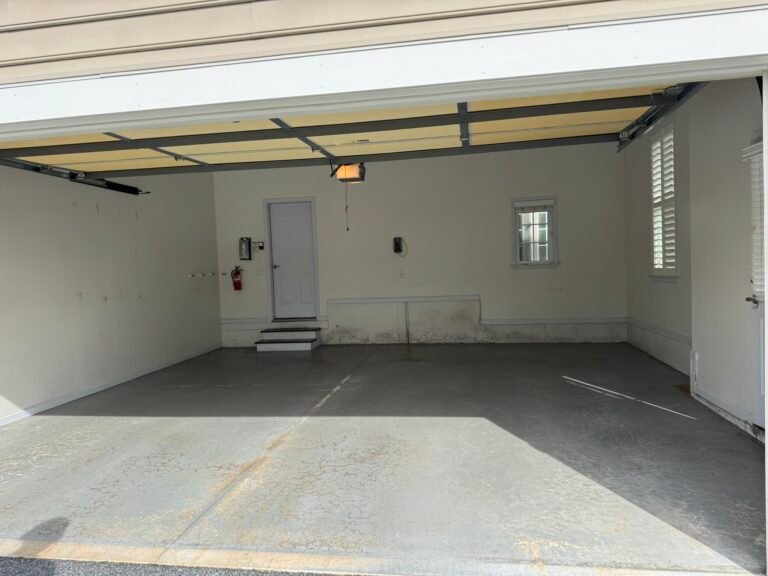
This is called hot tire pickup, and it’s immediately visible: dark, smeared marks near where your car’s tires rest, sometimes with chunks of coating lifted and deposited elsewhere. It happens almost exclusively with cheaper epoxy products, acid-etched surfaces, and hardware store kits. It essentially never happens with a properly installed polyaspartic system.
“I came home one day and there were pieces of floor stuck to my tires. I had no idea that was even possible. The coating had basically bonded itself to the tires more than to the concrete.”
— A homeowner in Lancaster County who called us after a big-box installer’s floor failed in year two
We do free, no-pressure inspections for Lancaster and Lebanon County homeowners. We’ll show you exactly what went wrong and what a proper fix looks like — no obligation to hire us.
Walk into any big-box home improvement store in Pennsylvania and you’ll find epoxy floor coating kits for $80–$150. The packaging shows beautiful, glossy garage floors. The instructions say “apply in a weekend.” What the packaging does not say is that these products typically last 12–18 months before peeling — and that’s if the application goes well.
The problem isn’t that homeowners do the work badly. The problem is the product itself. Box store kits use water-based epoxy at 30–50% solids — meaning roughly half of what you apply evaporates during curing, leaving a thin, weak film on top of the concrete. A professional-grade polyaspartic system uses 100% solids materials, building a thick, dense, chemically-bonded layer that the concrete grabs onto.
Additionally, most homeowners don’t have access to diamond grinding equipment. Without it — as we covered in Cause #1 — even the best product won’t hold long-term. The box store kit instructs you to clean the floor and apply. That’s not enough.
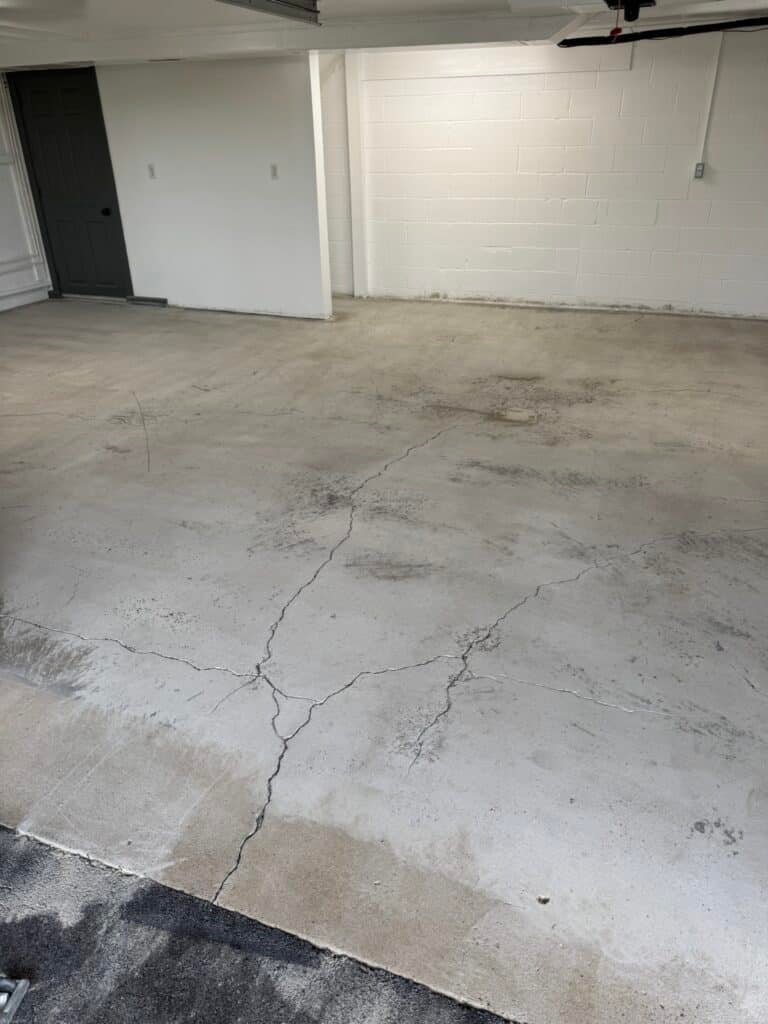
If your floor is already peeling, the fix is the same regardless of which of the five causes above is responsible. There are no shortcuts. You cannot coat over a failed coating and expect it to hold.
Everything has to come off. Any old paint, sealer, epoxy, or coating still bonded to the floor will compromise the new system. We use industrial floor grinders to remove old coatings and profile the concrete simultaneously.
Before anything goes down, we test the slab for moisture vapor emission. If readings are above acceptable levels, a moisture-mitigating primer is applied first. This step is skipped by most 1-day installers, which is why their floors eventually blister.
Every crack, joint, and pit is filled and leveled with professional-grade filler. The goal is a flat, sound substrate with no weak spots that can telegraph through the coating over time.
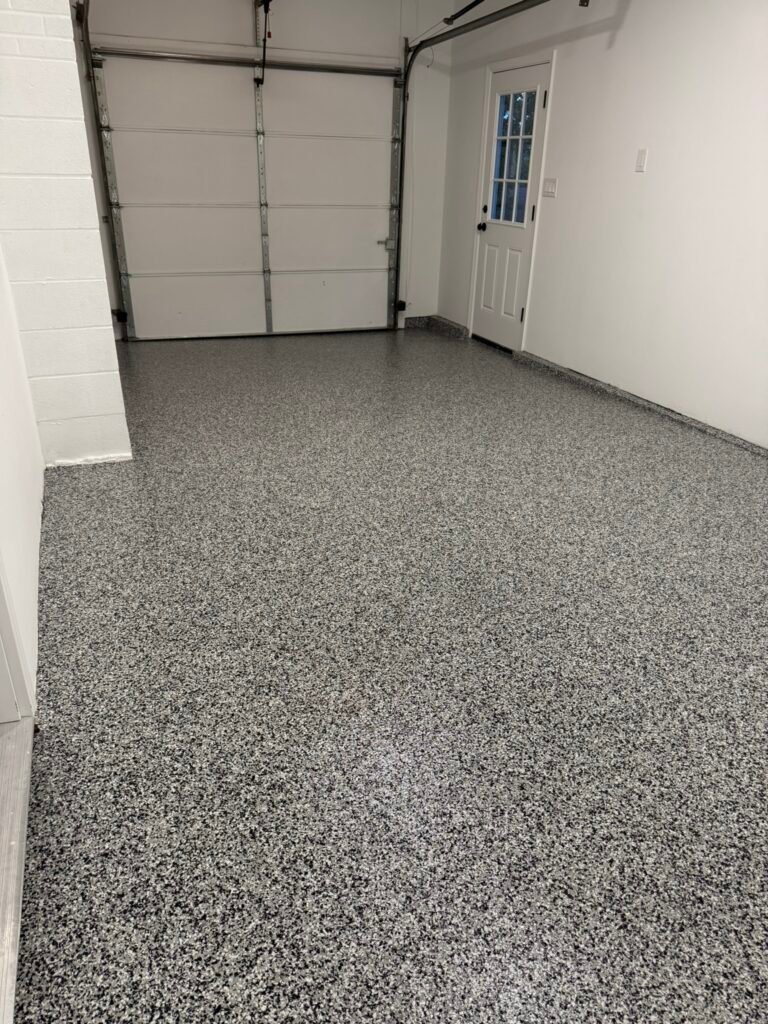
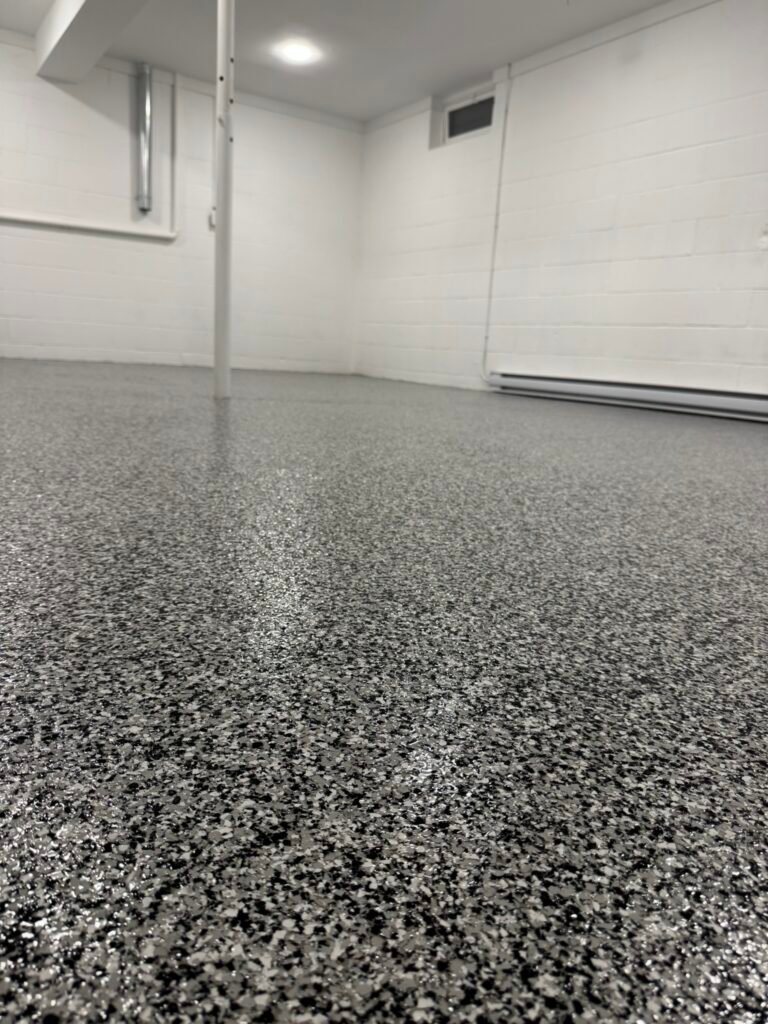
A 100%-solids polyaspartic base coat is applied to the profiled concrete, followed by a full-broadcast decorative flake layer, followed by a UV-stable polyaspartic topcoat. Each layer chemically bonds to the one beneath it. The result is a system — not just a coating — that handles Pennsylvania winters, road salt, hot tires, and heavy use for 15–20 years.
For a full look at how our garage floor epoxy installers approach every job, from grinding to topcoat, see our full garage floor coating page. Our completed projects gallery shows real before-and-after results from Central PA homeowners.
We strongly advise against it. A new coating applied over a failing bond is borrowing time — it may look fine for a season, but the underlying adhesion failure will resurface. The right approach is full removal first. It costs more upfront but eliminates the problem rather than delaying it.
A properly installed polyaspartic system should last 15–20 years in Pennsylvania. That number assumes diamond grinding, moisture testing, correct product selection, and full-solids materials. For a deeper look at lifespan by coating type, see our guide: How Long Does an Epoxy Floor Last? →
Usually, yes — but not always. Extreme moisture events, significant slab cracking due to settling, or a homeowner applying harsh chemicals to the surface can contribute to premature failure. That said, in our experience serving Lancaster and Lebanon County, the overwhelming majority of peeling floors we see trace back to one or more of the five causes above — all of which are controllable at installation. According to Penn State Extension’s guidance on concrete surfaces, proper surface preparation is the single most critical factor in coating adhesion and longevity. (external source)
Yes — significantly. The combination of freeze-thaw cycles, road salt, and our 80°F+ annual temperature swing makes this one of the harder climates for standard epoxy products. Polyaspartic coatings are specifically engineered to handle these conditions. Standard epoxy is not.
The simplest test: tape a piece of plastic sheeting (18″ × 18″) to the concrete with duct tape, seal all edges, and leave it for 24–48 hours. If moisture condensation forms on the underside of the plastic, you have elevated moisture vapor. A professional will use a calibrated moisture meter for a precise reading. Any competent installer should offer to do this before applying any coating.
We’re a local company based in Stevens, PA. We serve Lancaster and Lebanon County homeowners with honest assessments and proper installations — backed by a 15-year warranty against peeling.
📞 717-419-5885 | ✉️ flakeprocoatings@gmail.com
→ Request your free, no-obligation estimate — we respond the same day.