Pennsylvania’s Floor Coating Experts. Durable. Slip-Resistant. Installed in One Day [Get Free Quote]

It is a Saturday morning in Pennsylvania. You walk into a big-box home improvement store in Lancaster or York. You stroll down the paint aisle, and there it is: a shiny box promising a “Showroom Garage Floor” for $250. The box says “Polycuramine,” “Epoxy,” or perhaps even “Polyaspartic Floor Paint.”
It sounds perfect. You think, “Why should I pay a professional thousands of dollars when I can do it myself this weekend?”
It is a valid question. We respect the DIY spirit. Homeowners take pride in their work. But there is a dirty little secret in the coatings industry that those shiny boxes won’t tell you.
That box is designed to fail.
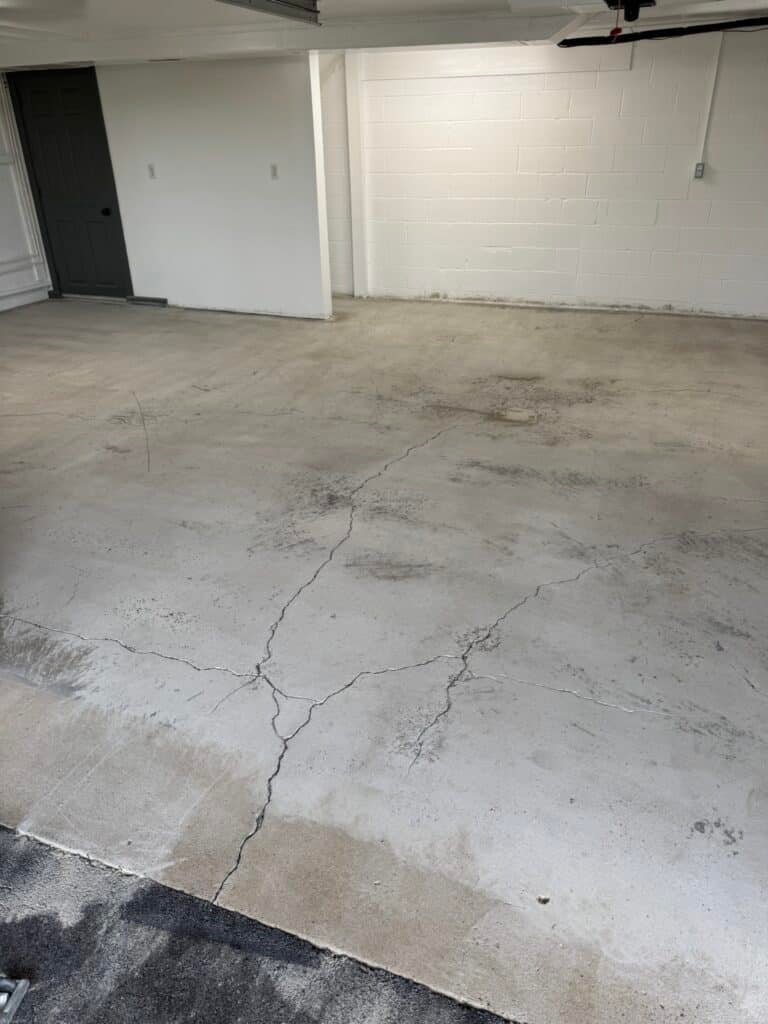
At FlakePro Coatings, we receive dozens of calls every spring from distressed homeowners asking: “My floor is peeling up under my tires. Can you fix it?” In almost every case, it was a DIY kit installed less than two years ago.
In this comprehensive guide, we are going to explain exactly why DIY polyaspartic floor paint kits fail, the chemistry behind the failure, and why a professional installation is actually cheaper in the long run.
First, let’s clear up a massive misconception. There is no such thing as polyaspartic “paint.”
Paint is a material that dries by evaporation (water or solvent leaves, leaving pigment behind). Polyaspartic is a resin that cures through a chemical reaction.
When marketing teams label a box as “Garage Floor Paint,” they are dumbing down the science. Real industrial flooring—the kind used in airplane hangars and high-end showrooms—is a high-solids resin system.
Here is the biggest difference between what is in the box and what is in our trucks: Solids Content.
The Result: The DIY kit creates a thin, brittle skin. The professional system creates a structural layer.
If you remember only one thing from this article, let it be this: A coating is only as good as the surface profile it sticks to.
This is where 95% of DIY polyaspartic coating for garage floor projects fail before the can is even opened.
DIY kits almost always include a bag of “etching powder” (usually citric or muriatic acid). The instructions say to mix it with water, scrub the floor, and rinse it off. Ideally, this “roughs up” the concrete. Why this is disastrous:
Real professionals never use acid. We use 800lb planetary grinders equipped with diamond-impregnated tooling.
When we apply our polyaspartic base coat, it doesn’t just sit on top; it flows into these open pores and hardens. This creates “mechanical interlock.” It becomes part of the concrete, not a sticker on top of it.
Read more about proper concrete preparation standards at the nternational Concrete Repair Institute (ICRI).
[Image Suggestion: Side by side photo. Left: A smooth concrete floor (bad for bonding). Right: A diamond-ground floor looking scratchy and white (perfect for bonding).]
Polyaspartic is famous for its fast cure time. This is a huge benefit for you because you get your garage back in 24 hours. But for a DIYer, it is a nightmare.
Professional polyaspartic formulations have a “pot life” (working time) of about 15 to 25 minutes once part A and part B are mixed.
The DIY Scenario: You mix the batch. You start rolling. The phone rings, or you realize you missed a spot in the corner. By the time you get halfway across the garage, the resin in the bucket is starting to gel. It becomes sticky. You start panic-rolling, leaving thick roller marks and streaks. The result is a floor that looks uneven, bubbly, and amateurish.
The Professional Scenario: We operate in teams. One technician is mixing small batches. Another is cutting in the edges. A third is rolling the main floor. We move with military precision because we work with this material every single day. We monitor the temperature and humidity (which affect cure time) and adjust our technique accordingly.
If you are searching for a “polyaspartic floor near me” in Lancaster, York, or Harrisburg, you need to account for our geography. We are not in Arizona. We deal with the Northeast infrastructure killer: Road Salt.
In winter, concrete acts like a rigid sponge. Ground moisture tries to push up through the slab (hydrostatic pressure). Simultaneously, salt water from your car tires tries to push down.
A thin DIY coating (remember, the thickness of two sheets of paper) cannot withstand these opposing forces.
A professional Garage Floor Coating is thick enough and flexible enough (elasticity) to withstand this expansion without breaking the bond.
Let’s break down the math. Many homeowners think they are saving $2,000 by doing it themselves. But are they?
Initial Cost: ~$1,000 + Your Weekend.
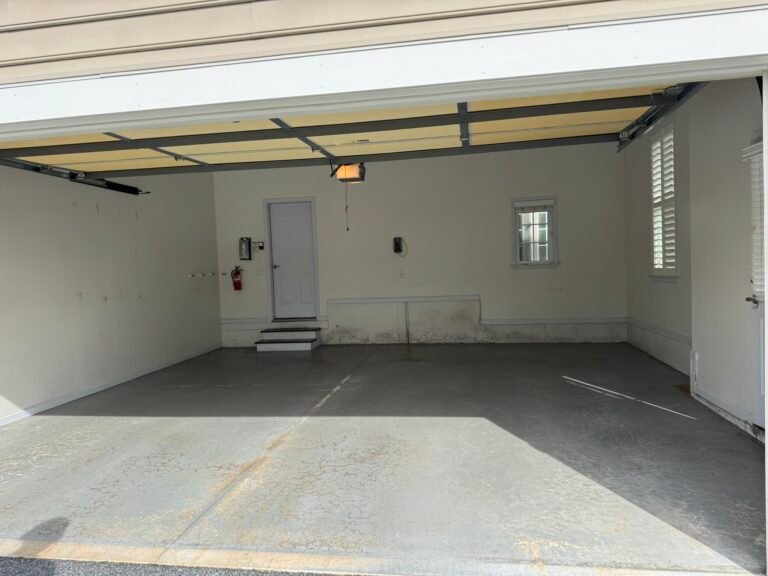
Fast forward 2 years. The floor is peeling where the tires sit (Hot Tire Pickup). It looks terrible. You decide to fix it.
Total Cost of DIY: $1,000 (First try) + $1,000 (Removal) + Pro Install Price. Result: You paid double, and you lived with an ugly floor for two years.
The FlakePro Value: You pay one price. You get a floor that lasts 15-20 years. You get a warranty. You get your weekend back.
So, if the box from the store is “trash,” what is the “treasure”?
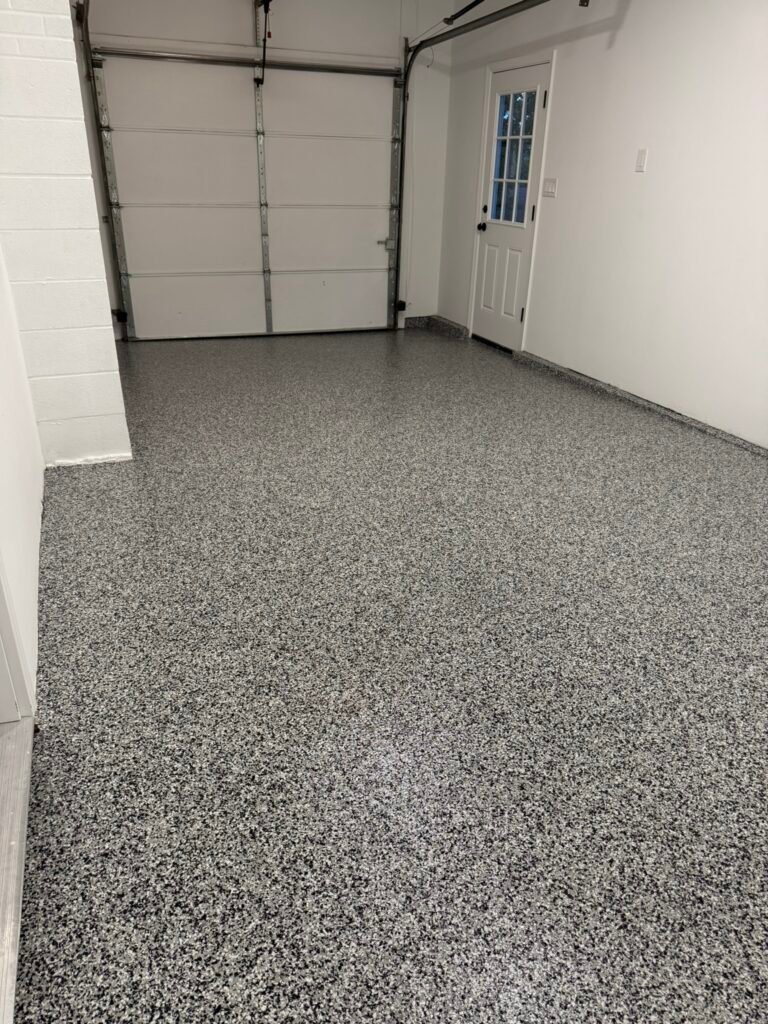
At FlakePro Coatings, we install a multi-layer, industrial-grade system designed specifically for the residential garage environment.
We use a pure polyaspartic (or moisture-mitigating epoxy, depending on your slab’s moisture reading) that wicks deep into the diamond-ground pores. This is the “anchor.”
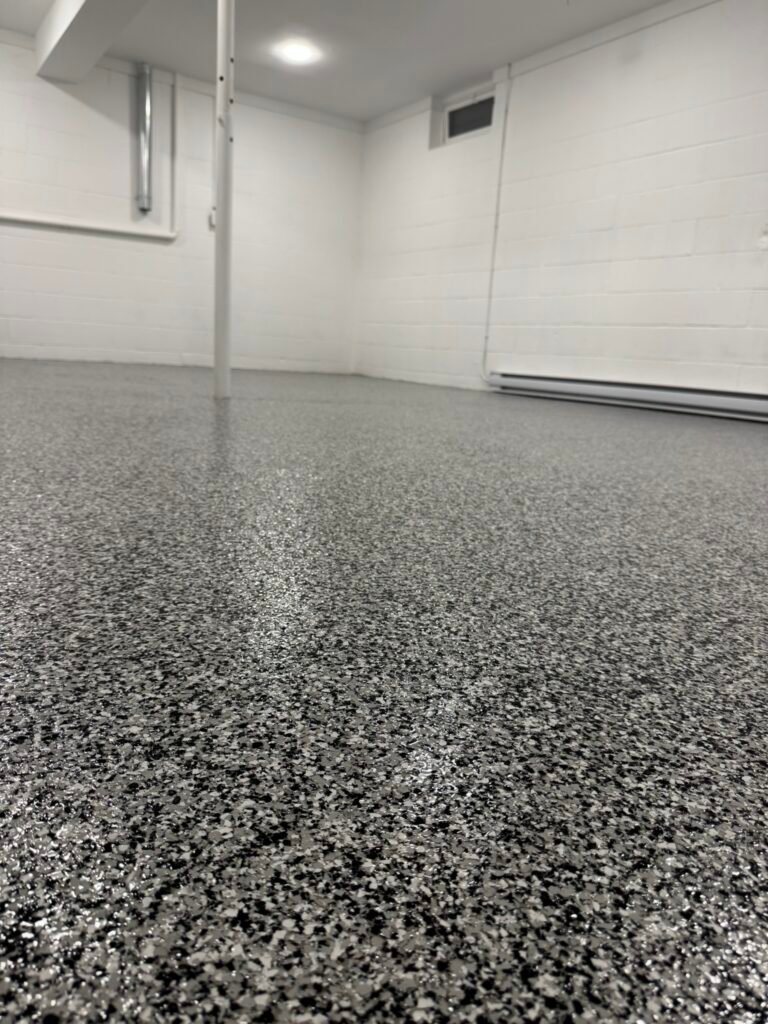
We broadcast vinyl chips to “rejection” (100% coverage). DIY kits usually give you a tiny bag of sprinkles that leave 80% of the floor showing. Why 100% Coverage Matters:
We apply a clear, UV-stable polyaspartic topcoat. This is the “shield.” It is chemical resistant (gas, oil, brake fluid), scratch-resistant, and non-yellowing.
Explore our different color options and textures in our Project Gallery.
We have seen the aftermath of DIY kits too many times.
“It looked like a peeling sunburn.” — Tom R., Mechanicsburg
“I bought the expensive kit from the paint store. I followed the instructions perfectly. Used the acid wash. Let it dry for two days. Within six months, I had four big strips peeling up right where I park my truck. FlakePro came out, showed me why it failed (moisture in the slab), and fixed it. I wish I called them first.”
“The fumes were unbearable.” — Sarah L., Lititz
“We tried to do our basement ourselves. The smell of the kit we bought lingered in the house for a week. We got headaches. The FlakePro team used a low-odor system, and we were back to using the basement the next day.”
We are not telling you this to scare you; we are telling you this to save you money.
There are many home improvement projects that are great for DIY: painting walls, landscaping, changing light fixtures. Resin-based concrete flooring is not one of them. It requires industrial equipment and chemical expertise that cannot be packaged in a cardboard box.
Don’t paint your floor. Protect it.
If you want a floor that withstands:
…then you need a professional polyaspartic system.
Stop looking at “polyaspartic floor paint” and start looking for a permanent solution.
Contact FlakePro Coatings today for a free, honest assessment of your concrete. We serve Lancaster, York, Harrisburg, and the surrounding communities.
Call us at 717-419-5885.